

| Pose | Typical hold | Props | Planning use |
|---|---|---|---|
| Supported child’s pose | 2 to 3 minutes per side in a short sequence; 5 to 10 minutes when held longer | Bolster between the legs | Start here for a gentle fold. Pick the shorter hold if time is tight. |
| Supine twist | 5 to 10 minutes per side | Block under the knees | Add it when the back wants a quiet release. Keep the same time on both sides. |
| Legs up the wall | 5 to 10 minutes with a blanket under the lower back; 10 to 15 minutes in a longer sequence | Wall, blanket, or bolster | The simplest pose to try on its own on a tired evening. |
| Reclined bound angle | 10 to 15 minutes | Support under the knees | Save it for a longer session, since it has one of the longest holds. |
| Corpse pose | 5 to 10 minutes | Blanket as needed | Always finish with it. It is the rest the other poses lead to. |
Hold times above come from the Cleveland Clinic’s restorative yoga guide and a teacher-written sequence in Yoga International.
Restorative yoga uses props to support the body so it can fully relax, rather than stretch or strengthen. Hold a few poses in complete comfort, and treat any discomfort as a signal to adjust the setup.
For the wider context of calming practices, see this guide to yoga for stress relief across different stages of life.
What restorative yoga is and who it suits
The Cleveland Clinic describes restorative yoga as designed to give a period of complete mental and physical relaxation. A Yoga International teacher defines it as poses in which the body is supported and made comfortable by props. Calm calls it a movement practice that lets the body and mind rest and recharge.
The practice centres the parasympathetic nervous system, according to the Cleveland Clinic. Yoga International makes the same point: the poses aim to elicit the relaxation response in that system. In practice, the body is held still and fully supported, so there is nothing to work against.

It suits people who want to slow down after a demanding day or week. It also suits people who find active classes too much. It is less suited to anyone who wants a workout, because the goal is relaxation rather than active stretching or strengthening. Anyone comparing it with yoga for weight loss should expect a different kind of session, built around rest.
Props and household substitutes
Cleveland Clinic lists bolsters, blankets and pillows as the usual supports for the knees, neck and lower back. Calm adds blocks and other support tools. A bolster is the one prop worth buying first, and you can improvise the rest from what is already in the house.
- Bolster or blankets. A Yoga International sequence calls for one bolster or two to three firm blankets.
- A folded blanket as a bolster. Fold firm blankets so that, when stacked, they resemble a bolster. That is the most practical substitute for a first routine.
- Pillows. Use them to support the knees, neck or lower back, as the Cleveland Clinic describes.
- Yoga blocks. These go under the knees in the supine twist. If you have none, pillows can take the knees’ weight.
The deciding rule is comfort. As the Yoga International teacher puts it, the most important part of restorative practice is to be comfortable. Adjust the props until the body can fully relax, and replace anything that digs in or leaves a limb hanging unsupported.
Restorative yoga vs yin yoga
The clearest line between the two sits in the goal. A Yoga International teacher states that the goal of restorative practice is not to actively stretch or strengthen. Calm likewise contrasts it with more active forms of yoga that focus on strengthening and stretching, and emphasises rest and stillness instead.
That gives a practical test when choosing a class or video labelled yin or restorative:
- Check the aim. If the stated aim is relaxation, with the body supported in each pose, it fits restorative practice.
- Check the props. Restorative poses lean on props to carry the body. A session that asks you to feel a stretch is working toward a different purpose.
- Check the comfort standard. Cleveland Clinic says there should be no discomfort in restorative poses. Treat any strain as a cue to add support or leave the pose.
If a class description is unclear, ask the teacher which aim the session serves. Pick restorative yoga when the aim for the evening is to unwind rather than to stretch.
A home routine in phases
Restorative sessions hold fewer poses for longer, typically five to ten minutes per pose or longer, according to the Cleveland Clinic. The routine below moves from setup through folding and opening to rest. Work through it in order, or choose two or three poses on a short evening.
Settle in and set the timer
- Gather a bolster or folded blankets, pillows, a block and a clear stretch of floor beside a wall.
- Set a five-minute or ten-minute soft timer for each pose, as Cleveland Clinic suggests, so you are not watching the clock.
- Dim the room and lie down for a moment before choosing the first pose.
Fold: supported child’s pose
Supported child’s pose is the gentlest way in. Cleveland Clinic advises putting a bolster between the legs for balance, with a hold of five to ten minutes. A shorter Yoga International sequence holds it for two to three minutes with the head turned to the right, then switches sides.
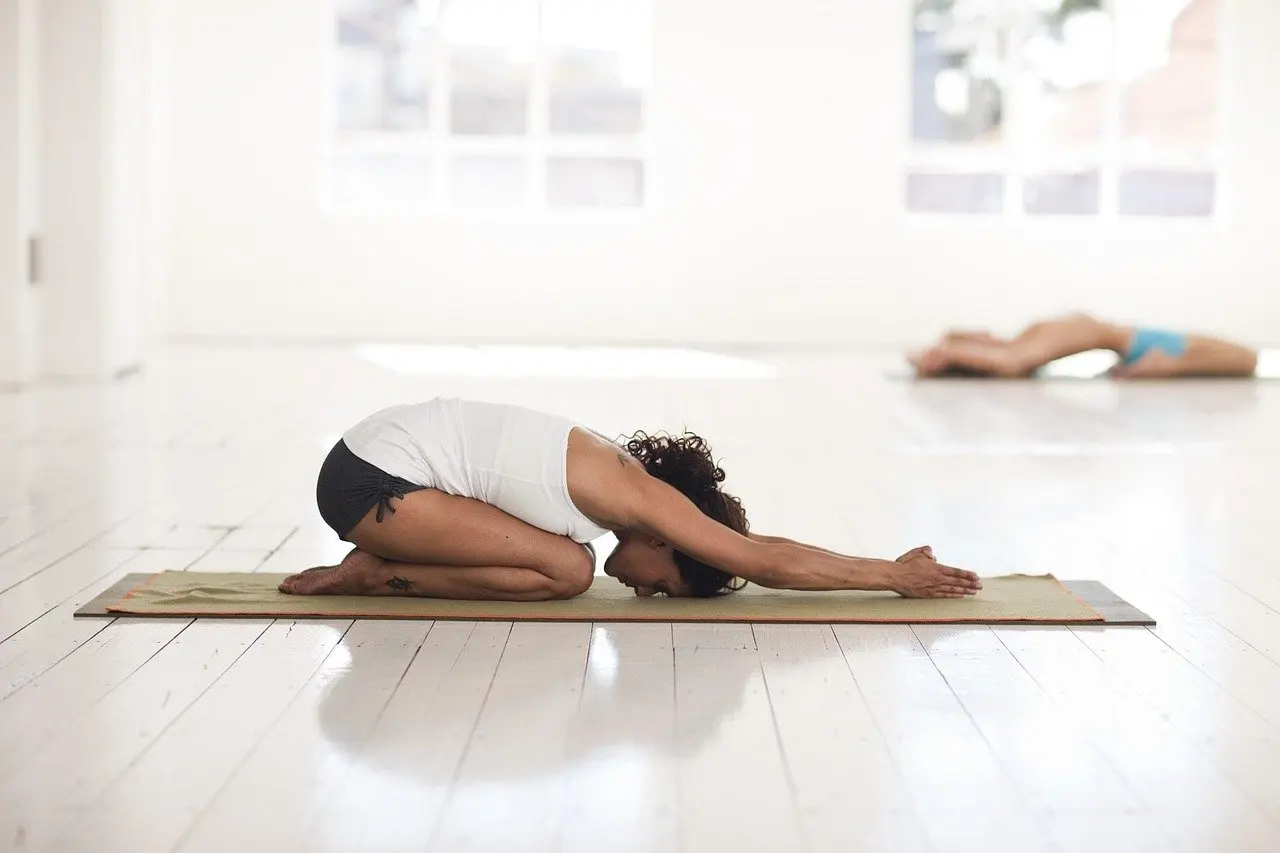
- Kneel and fold forward, with the bolster between your legs and under your torso.
- Turn your head to the right and rest.
- Stay for the timer, then turn your head to the left and repeat.
Open: twist and reclined bound angle
For the supine twist, place a block under the knees and hold five to ten minutes per side, as the Cleveland Clinic describes. Reclined bound angle (supta baddha konasana) follows, held for ten to fifteen minutes in the Yoga International sequence. Support under the knees keeps the legs from straining.

- Lie on your back and lower both knees to one side over the block. Stay for the timer.
- Switch sides and hold for the same time.
- Bring the soles of your feet together and let your knees fall open onto their supports.
- Stay for the longest hold of the session, then roll to the side to come up.
Lift: legs up the wall
Legs up the wall asks for little equipment. The Cleveland Clinic suggests five to ten minutes with a blanket under the lower back. Yoga International allows ten to fifteen minutes, with the legs on the wall and the body on the floor, blankets or a bolster.
- Sit sideways next to the wall and swing your legs up as you lie back.
- Slide a folded blanket under your lower back.
- Let your arms rest open and stay for the timer.
Rest: corpse pose
Corpse pose (savasana) closes the session. Yoga International gives five to ten minutes. Let the props stay in place and lie still. You can move attention through the body slowly, as in a body scan meditation.
What the research says
Cleveland Clinic points to several studies of restorative yoga. A 2018 study of cancer survivors compared a 12-week restorative yoga program against a 12-week vigorous yoga program. A 2022 study found improved fluid cognitive function after 24 weeks of restorative yoga compared with vigorous yoga. These comparisons show restorative yoga being tested as a distinct practice, not just a gentler warm-up.
Calm notes that experts recommend 7 to 9 hours of sleep a night for adults. That benchmark gives a way to judge whether an evening routine is helping, though the figure is a general guideline and not a result of restorative yoga itself. Treat the research as encouraging rather than a promise of any particular outcome.
Safety, injuries and pregnancy
Calm describes restorative yoga as an accessible practice for people recovering from injuries or chronic pain. Cleveland Clinic sets the standard for everyone: there should be no discomfort in your poses. If a pose pulls, tingles or hurts, add support or skip it.
Anyone who is pregnant, recovering from surgery or managing a diagnosed injury should check the routine with a doctor, midwife or physiotherapist before starting. They can advise which positions suit that situation. Lying flat, inverted positions and twists are the poses most worth raising.
Troubleshooting a routine at home
- The pose feels uncomfortable. Change the props rather than push through. Comfort is the most important part of restorative practice, according to Yoga International.
- You have no bolster. Stack firm folded blankets until they resemble one.
- Time is short. Choose fewer poses and keep the holds long enough to settle, since restorative sessions hold fewer poses for longer.
- You watch the clock. Use the soft timer so the end of each pose arrives without checking.
Frequently asked questions
Does restorative yoga build strength or flexibility?
Not as a goal. A Yoga International teacher states that the aim is not to actively stretch or strengthen, but to relax the body.
Is a weekly session enough to start?
A 2023 medical student study described by Cleveland Clinic used a 45-minute restorative yoga session once a week for six weeks. That schedule is a reasonable template for beginners, not a prescribed dose.
Which pose should a beginner try first?
Legs up the wall asks only for a wall and a folded blanket, so it is an easy first pose. Add supported child’s pose once that feels comfortable.